Selling a Home in Lodi? Why the First 30 Days Matter Most
By Jesse J. Rivas, Realtor® | Jesse Rivas Realty, Keller Williams Central Valley | DRE #02282782 | Published November 2026
Local Market Update Series: Part 1, SJ County Market Update (Aug–Oct 2026) | Part 2, Sellers: Why the First 30 Days Matter | Part 3, Buyers: More Choices, More Leverage
Quick answer
In October 2026, Lodi homes that sold within their first 30 days on the market closed at 99.8% of list price. Homes that took 31–60 days closed at 96.4%, and homes that took 61–90 days closed at 94.0%. On a home listed at Lodi’s $599,400 median list price, that’s about a $35,000 difference. Across San Joaquin County, about 1 in 3 listings that left the market in October expired without selling. The first month on the market is a seller’s best opportunity, and it’s won or lost before the sign goes up.
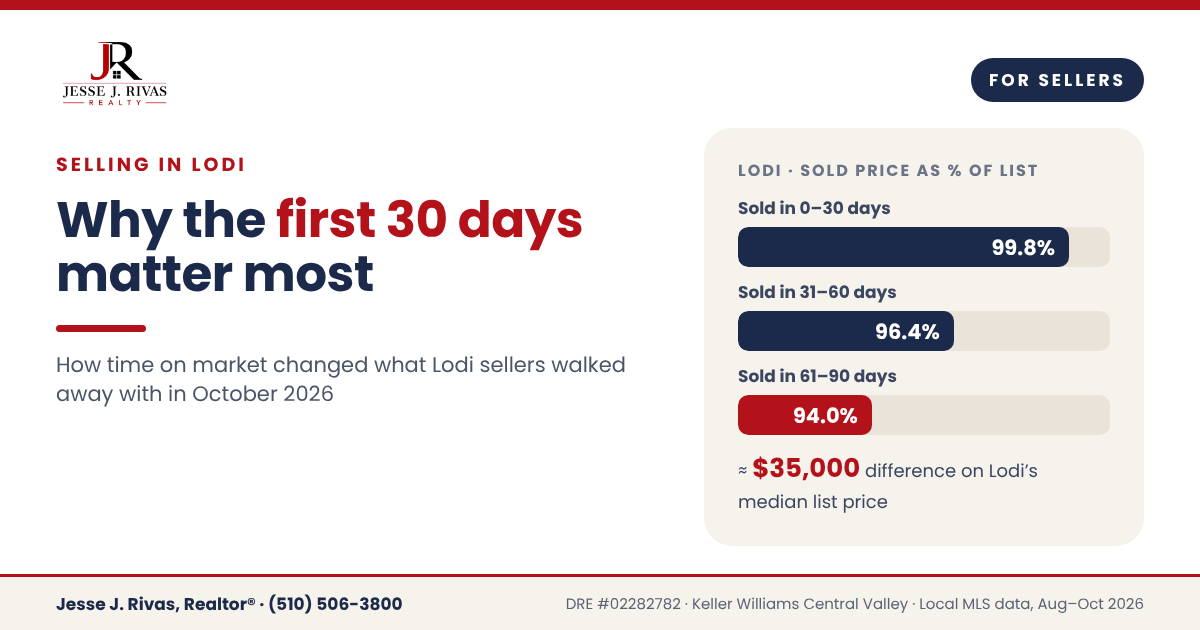
Sold price vs. list price by time on market
| Area (Oct 2026) | Sold in 0–30 days | 31–60 days | 61–90 days |
| Lodi | 99.8% | 96.4% | 94.0% |
| Stockton | 100.4% | 98.0% | 99.2% |
| Galt | 100.1% | 100.6% | 98.9% |
| Elk Grove | 99.4% | 98.3% | 93.1% |
| Lathrop | 97.7% | 93.8% | 98.3% |
| San Joaquin County | 99.3% | 98.1% | 97.8% |
Source: local MLS data compiled by Jesse Rivas Realty, Aug–Oct 2026. Deemed reliable but not guaranteed. Percentages compare the final sale price to the list price at the time of sale.
One detail matters when you read this table. The percentage is measured against the list price at the time of sale. If a home started at $650,000, was reduced to $610,000 and then sold at 96% of that, the seller got about $585,600. That’s roughly 90% of the original asking price. A home that lingers doesn’t just sell at a lower percentage; it often sells at a lower percentage of a lower price.
What that looks like in dollars
| Home listed at… | Sold in 0–30 days (99.8%) | Sold in 31–60 days (96.4%) | Sold in 61–90 days (94.0%) |
| $450,000 | About $449,100 | About $433,800 | About $423,000 |
| $599,400 (Lodi median) | About $598,200 | About $577,800 | About $563,400 |
| $750,000 | About $748,500 | About $723,000 | About $705,000 |
Illustrative math using Lodi’s October 2026 sold-to-list ratios. Your home’s result will depend on its condition, location and price.
The market isn’t what hurts most sellers. Overpricing and poor preparation do. Buyers notice new listings fast, and they notice when a home has been sitting.
Why the first 30 days carry so much weight
Nothing magical happens on day 30. The pattern comes from how buyers actually shop:
- Buyers are alerted the moment you list. Most active buyers have saved searches on Zillow, Realtor.com or through their agent. A new listing goes straight to every buyer whose search it matches, so the first week brings your largest, most motivated audience.
- The buyers who’ve been waiting move first. People who already toured everything in your price range and are ready to write an offer see your home as the new option they’ve been waiting for.
- Time on market changes how buyers read your home. After a few weeks, buyers start to ask what’s wrong with it. Even if nothing is, the question gives them a reason to offer less.
- Price reductions invite negotiation. Once a home has been reduced, buyers often assume the seller will come down more, so offers come in lower than they would have at the start.
- Holding costs add up. Every extra month means another mortgage payment, property taxes, insurance, utilities and upkeep on a home you’re trying to leave.
The other number sellers should know: 1 in 3 listings expired
In October, 218 listings expired across San Joaquin County, compared with 401 that sold. About 35% of the listings that came off the market didn’t sell, and in Lodi it was 38%. In the same month, 141 homes went under contract countywide.
In other words, buyers were out there. They chose other homes. In my experience, an expired listing usually comes down to one or more of these:
- Priced from hope instead of data. The list price was set based on an online estimate, a neighbor’s sale from a stronger month, or what the seller needs to walk away with, rather than what comparable homes are actually selling for now.
- Condition didn’t match the price. Deferred repairs, dated finishes, or a tired yard made the home look overpriced next to similar listings.
- Weak first impression online. Dark photos, too few photos, or a thin description meant buyers scrolled past.
- Hard to see. Limited showing windows, an occupied home that wasn’t ready, or pets and tenants that complicated access.
- Adjusting too late. By the time you corrected the price, the home had sat long enough to make buyers wary.
How to price your home to win the first month
Pricing is the single biggest decision you’ll make, and it should come from evidence:
- Use recent sales near you. Closed sales from the last 60–90 days, as close to your home in size, age, condition and location as possible, carry the most weight.
- Study what’s active and pending. Active listings are your competition. Pending sales show what buyers are choosing right now.
- Learn from what expired. Homes that didn’t sell tell you where buyers drew the line.
- Think in search ranges. Buyers search in brackets like “up to $600,000.” A home listed at $604,900 never shows up for a buyer whose search tops out at $600,000. Pricing just inside a common bracket can widen your audience.
- Separate value from need. What you need to net matters for your plan, but buyers don’t know it and won’t pay for it. If the numbers don’t work, it’s better to find out before you list.
Your 30-day launch plan
| When | What happens |
| 2–3 weeks before listing | Walk-through and pricing review; fix obvious repairs; declutter; touch up paint, landscaping and lighting; consider a pre-listing inspection for an older home |
| Listing week | Professional photos and a clear, specific description go live; showings open with flexible times |
| First two weekends | Maximize showings and open houses while buyer interest is highest |
| Day 14 | Review showing activity, online views and buyer feedback together. If interest is light, adjust now |
| Days 15–30 | Respond quickly to offers, negotiate repairs and credits strategically, and keep the home show-ready |
You don’t need to renovate to sell well. Small, inexpensive fixes that remove buyer objections, such as paint, lighting, landscaping, a leaky faucet or a sticking door, usually matter more than big projects.
Should you sell now or wait until spring?
Spring typically brings more buyers, but it also brings more competing listings. Right now, buyers are active (141 homes went under contract countywide in October) and many sellers have stepped back for the holidays. A well-prepared home listed in late fall or winter can stand out.
The right timing depends on your situation: where you’re moving, whether you need to buy at the same time, school calendars, your equity, and your current interest rate. If you have a low rate on your existing loan, it may be assumable for a qualified buyer, which can make your home more attractive when new rates are above 7%. That’s worth a conversation with your lender and with me before you list.
Know your net before you list
Your sale price isn’t what you walk away with. Before you decide anything, look at an estimated net sheet that includes your loan payoff, any credits to the buyer, commissions, title and escrow fees, transfer taxes, and prorated property taxes. Seeing your net on paper helps you decide whether selling now fits your plan, what your next home budget is, and how much room you have to negotiate.
Key terms
| Term | What it means |
| Days on market (DOM) | How long a home was listed before going under contract |
| Sold-to-list ratio | Final sale price divided by list price |
| Expired listing | A listing whose agreement ended without the home selling |
| Net proceeds | What you walk away with after your loan payoff and selling costs |
| Assumable loan | A mortgage a qualified buyer can take over, often at the seller’s original rate |
Frequently asked questions
Q: Is now a good time to sell my house in Lodi?
A: Buyers became more active in fall 2026: the number of homes going under contract in San Joaquin County rose from 21 in August to 141 in October, and the county median list price held around $585,000. Whether it’s right for you depends on your equity, your next move and your timeline.
Q: How much do Lodi homes sell for compared with list price?
A: In October 2026, Lodi homes averaged 97.5% of list price overall, and 99.8% when they sold within the first 30 days.
Q: Why do some homes not sell?
A: Most often because of price, condition or presentation. About 35% of San Joaquin County listings that left the market in October 2026 expired without selling, even though buyer activity was rising.
Q: Should I wait until spring to sell?
A: Spring often brings more buyers but also more competing listings. With fewer listings in late fall and active buyers, some sellers benefit from listing now.
Q: How long does it take to sell a house in Lodi?
A: The median Lodi home went under contract in 38 days in October 2026, and closing typically takes another 30–45 days.
The bottom line
Your best offers usually come early. A strong pricing and preparation plan, built on what’s actually selling near you, is worth more than any headline or online estimate. If you’re thinking about selling, even months from now, let’s look at your numbers together so you can decide with confidence.
Want the numbers for your neighborhood or your situation? Text PLAN to (510) 506-3800, email JesseRivas@KW.com, or send me a DM. We’ll do a free 15-minute call, no pressure. Buyers: I’ll connect you with a trusted lender so you know your real budget. Sellers: I’ll show you what your home could sell for and what you’d walk away with.
About the author
Jesse J. Rivas is a Realtor® with Keller Williams Central Valley who lives in Lodi and works with buyers and sellers across Lodi, Stockton, Galt, Elk Grove, Lathrop, Manteca and the rest of San Joaquin County. Before becoming an agent, he bought and sold several homes of his own, and he pulls local MLS numbers every month so his clients make decisions on real data instead of headlines. He also helps homeowners facing financial hardship understand their options before foreclosure.
Sources
- Local MLS data for San Joaquin County, Lodi, Stockton, Galt, Elk Grove and Lathrop, compiled by Jesse Rivas Realty (Aug–Oct 2026)
- Freddie Mac Primary Mortgage Market Survey, Nov 19, 2026
Jesse J. Rivas, Realtor® | DRE #02282782 | Jesse Rivas Realty | Keller Williams Central Valley, Broker DRE #02324551 | Equal Housing Opportunity. Market data is from the local MLS, compiled by Jesse Rivas Realty for Aug–Oct 2026; information is deemed reliable but not guaranteed. “Median price” refers to median list price. Payment examples are illustrative estimates, not loan quotes or financial advice.


