
Part 2: How to Lower Your Mortgage Payment in 2026 — Seller Credits, 2-1 Buydowns and Points, Explained
Posted on October 11, 2026 Leave a Comment
Jesse J. Rivas, REALTOR® | Keller Williams Central Valley | Updated October 6, 2026

Quick answer: The three most common ways to lower a mortgage payment when rates are high are (1) asking the seller for a credit toward closing costs, (2) a temporary 2-1 buydown that lowers the rate by 2% in year one and 1% in year two, and (3) paying points for a permanently lower rate. With sellers offering concessions at record levels, many buyers can have the seller pay for some or all of these.
Our example home
To keep things real, every example below uses the same purchase: a $525,000 home (close to the San Joaquin County median), 5% down, a $498,750 loan, and a 7.25% 30-year fixed rate. Figures are principal and interest only.
Step 1: Ask for a seller credit toward closing costs
A seller credit is money the seller agrees to put toward your closing costs. Instead of asking for $15,000 off the price, you might ask for a $15,000 credit. A price cut of that size lowers the payment by only about $100 a month, while a credit can cover real costs at closing or pay for a buydown.
Every loan type limits how much a seller can contribute, often between 3% and 9% of the price depending on the program and your down payment. Your lender will confirm your limit before you write the offer.
Step 2: Consider a temporary 2-1 buydown
With a 2-1 buydown, money is set aside at closing to reduce your rate for the first two years. You still qualify at the full rate.
| Year | Effective rate | Monthly P&I | Savings vs. 7.25% |
| Year 1 | 5.25% | $2,754 | $648/mo |
| Year 2 | 6.25% | $3,071 | $331/mo |
| Years 3–30 | 7.25% | $3,402 | — |
The total cost of this buydown is about $11,756 — roughly 2.2% of the price. A 3% seller credit on this home ($15,750) could pay for it and still leave money for other closing costs.
- Good fit: buyers expecting raises, a second income, or who want breathing room in the first two years.
- Not a fit: anyone who can only afford the year-one payment. Year three always arrives.
Step 3: Compare a permanent buydown (paying points)
A point equals 1% of your loan amount. Paying points lowers your rate for the life of the loan. Pricing changes daily and differs by lender.
Example: if one point ($4,988) lowers the rate from 7.25% to 7.00%, the payment drops from $3,402 to $3,318 — about $84 a month. It takes about 59 months (five years) to break even. If you sell or refinance before then, you may not recover the cost.
Step 4: Shop loans and lenders
- Compare FHA, VA and conventional options — they price differently depending on your credit and down payment.
- Ask about down payment assistance programs you may qualify for.
- Get quotes from more than one lender, and compare the Loan Estimates line by line.
Which option is right for you?
| If your priority is… | Consider | Why |
| Less cash at closing | Seller credit | Covers fees you’d otherwise pay out of pocket |
| Lower payment early on | 2-1 buydown | Biggest savings in the first two years |
| Lower payment for decades | Points | Savings last the life of the loan if you keep it |
| Flexibility to refinance | Seller credit or 2-1 | Points pay off only if you keep the loan for years |
Frequently asked questions
If I refinance during a 2-1 buydown, do I lose the leftover money?
Under many programs, unused buydown funds are applied to your loan balance at payoff, but rules vary. Ask your lender how unused funds are handled before you choose.
Can I combine a seller credit and a buydown?
Yes — a seller credit is often the money that pays for the buydown. The total still has to stay within your loan’s seller-contribution limit.
Want real numbers on your situation? Call or text Jesse at (510) 506-3800 or email JesseRivas@KW.com. No pressure — just the information you need to decide.
About the author: Jesse J. Rivas is a REALTOR® with Keller Williams Central Valley (DRE #02282782) serving Lodi, Stockton, Manteca, Modesto and San Joaquin County. He has bought and sold homes himself and works with first-time buyers, move-up buyers, sellers, and homeowners facing financial hardship.
Buying in 2026 series: Part 1 — Buying When Rates Are Above 7% • Part 2 — How to Lower Your Mortgage Payment • Part 3 — Marry the House, Date the Rate
Sources: Freddie Mac PMMS (Oct 1, 2026); Redfin seller concession data (2026). Payment examples are illustrations only, not a loan offer, rate quote, or financial advice. Jesse Rivas is not a lender or financial advisor. Confirm rates, program eligibility and seller-contribution limits with a licensed mortgage professional.
Part 1: Should You Buy a Home When Mortgage Rates Are Above 7%? What Lodi and San Joaquin County Buyers Should Know
Posted on October 9, 2026 Leave a Comment
Quick answer: Mortgage rates averaged 7.28% for a 30-year fixed in early October 2026, about a point higher than a year earlier. But high rates have pushed many buyers to the sidelines, which has given the buyers who remain more negotiating power — including seller-paid closing costs and rate buydowns. Whether buying makes sense depends on your payment comfort, savings, and how long you plan to stay, not on the headlines.
Where are mortgage rates right now?
According to Freddie Mac’s weekly survey released October 1, 2026, the 30-year fixed rate averaged 7.28%, up from 7.03% the week before and 6.34% a year earlier. It is the first stretch above 7% since early 2025.
That average assumes 20% down and excellent credit. Your actual rate depends on your credit score, down payment, loan type (FHA, VA, conventional), and whether you pay points. On a loan of about $500,000, every 1% change in rate moves the monthly principal and interest by roughly $300 or more.
Why do buyers have more leverage when rates are high?
When rates rise, fewer buyers can or will move forward. Fewer buyers means more homes sitting longer, and sellers who need to sell start competing for the buyers who are left.
- Redfin reported that nearly half of US home sales in August 2026 included a seller concession — the highest August share on record — and described August as the strongest buyer’s market in its data going back to 2013.
- In San Joaquin County, Zillow’s late-spring 2026 data showed about 48% of homes selling below list price.
- Not every market is the same. Redfin noted San Francisco remains one of a handful of seller’s markets, which is one reason many Bay Area buyers are looking at the Central Valley.
In 2021 and 2022, many buyers waived inspections and paid over asking just to be considered. Today, a well-prepared buyer can often negotiate repairs, credits, and price. That is a real advantage, even at a higher rate.
What can buyers negotiate for in this market?
| Ask for | What it does | Best for | Keep in mind |
| Credit toward closing costs | Lowers cash needed at closing | Buyers short on cash | Loan programs cap seller contributions |
| Temporary rate buydown (2-1) | Lowers payment in years 1–2 | Buyers expecting income growth | Payment rises in year 3 |
| Permanent rate buydown (points) | Lowers rate for the life of the loan | Buyers staying 5+ years | Break-even often takes years |
| Repairs or price reduction | Lowers cost or future expenses | Homes needing work | Price cuts change the payment only modestly |
Part 2 of this series walks through each of these with real payment examples.
Is buying right now right for everyone?
No. If the payment only works in a perfect month, or if closing would drain your emergency savings, waiting is a smart choice. A home comes with repairs, taxes and insurance that renters do not carry.
But if you can comfortably afford the payment today, it is worth comparing what waiting could cost you. Part 3 covers that, along with the popular saying “marry the house, date the rate.”
How do I know if buying makes sense for me?
- Know your comfortable payment — the number that still leaves room for savings and life.
- Get pre-approved so you know your real rate and loan options, not the national average.
- Count your cash to close, including down payment, closing costs and a cushion.
- Decide how long you plan to stay. Five years or more makes buying, and buydowns, easier to justify.
- Look at real homes and real numbers in Lodi, Stockton, Manteca or wherever you want to live.
Frequently asked questions
Will mortgage rates go down in 2027?
No one can say for sure. Rates move with inflation, the economy and the bond market. Plan around a payment you can afford today, and treat any future drop as a bonus.
Are sellers in Lodi paying buyers’ closing costs?
Many are willing to, especially on homes that have been on the market for a while. It depends on the home, the price point and the seller’s situation, so it is negotiated one deal at a time.
Is it better to rent until rates drop?
Sometimes. If buying would stretch you, renting is reasonable. If you can afford to buy now, compare a year of rent and possible price increases against the chance of a lower rate later.
Want real numbers on your situation? Call or text Jesse at (510) 506-3800 or email JesseRivas@KW.com. No pressure — just the information you need to decide.
About the author: Jesse J. Rivas is a REALTOR® with Keller Williams Central Valley (DRE #02282782) serving Lodi, Stockton, Manteca, Modesto and San Joaquin County. He has bought and sold homes himself and works with first-time buyers, move-up buyers, sellers, and homeowners facing financial hardship.
Buying in 2026 series: Part 1 — Buying When Rates Are Above 7% • Part 2 — How to Lower Your Mortgage Payment • Part 3 — Marry the House, Date the Rate
Sources: Freddie Mac Primary Mortgage Market Survey (Oct 1, 2026); Redfin seller concession report (Sept 18, 2026); Zillow San Joaquin County market data (May 2026). Payment examples are illustrations only, not a loan offer, rate quote, or financial advice. Jesse Rivas is not a lender or financial advisor. Confirm rates, program eligibility and seller-contribution limits with a licensed mortgage professional.
Choosing a Home That Fits a Single-Parent Life
Posted on October 6, 2026 Leave a Comment
A practical guide for single parents evaluating homeownership on one primary income
When you begin looking at homes, it is natural to focus on price, bedrooms, bathrooms, and appearance.
But if you are managing a household primarily by yourself, the right home needs to do more than look good during a showing. It should support the way your family actually lives.
That means considering three separate categories: what your family needs, what would be nice to have, and what would make everyday life easier. That third category is often overlooked.
Start With What Your Family Needs
Needs are the features that a home must have for the purchase to make sense. Your list might include:
- Enough bedrooms
- A workable school or childcare location
- A payment within your comfort range
- A reasonable commute
- A safe and functional layout
- Space for a home office
- Accessibility requirements
- Proximity to family or another support network
Keep this list focused. If everything is a need, it becomes hard to compare homes or stay within your financial guardrails.
Identify What Would Be Nice to Have
These are features you would enjoy but could compromise on if the right home met your larger goals. Examples include an updated kitchen, a large backyard, an extra bathroom, a pool, a particular architectural style, or new finishes.
There is nothing wrong with wanting these things. The key is knowing which features are worth paying more for and which aren’t.
Ask What Would Make Life Easier
For a single parent, convenience is not always a luxury. It can affect your finances, time, and stress level.
- A shorter drive to work
- Quick access to school or childcare
- Proximity to relatives who help with your children
- A low-maintenance yard
- A newer roof, HVAC system, or major appliances
- A bedroom arrangement that works for your children
- Useful storage and a manageable amount of space
A longer commute can mean more fuel, vehicle maintenance, childcare time, and fewer hours at home. A larger property can provide space but also create more cleaning and maintenance. Look at the whole impact, not just the purchase price.
Consider the Cost of Ownership Before You Offer
Every home comes with expenses beyond the mortgage payment. Investigate property taxes, homeowners insurance, HOA dues, special assessments, utilities, and the condition of the roof, HVAC, plumbing, electrical system, and major appliances.
A home inspection can help uncover concerns, although it cannot predict every future repair. Review the findings carefully and consider how potential expenses fit with the savings you intend to keep after closing.
Depending on the market and property, your agent may be able to negotiate repairs, credits, a home warranty, or assistance with closing costs.
Stress Test the Decision
Before saying yes to a home, test the payment against real-life situations:
- How would this feel if childcare costs went up?
- Could I cover an unexpected repair?
- What if I had an unusually expensive month?
- Would I still be able to save?
- Does the location reduce or increase daily expenses?
- How much money would I have left after closing?
The purpose isn’t to scare you out of buying. It is to make sure the home still works when life is not perfectly predictable.
Choose Improvement, Not Perfection

The right home does not need to solve every problem or include every feature on your wish list. It should create enough meaningful improvement to justify the financial commitment.
Instead of asking only, “Which house do I like best?” ask, “Will this home improve our daily life enough to make the payment and responsibility worthwhile?”
Build the Plan Before the Search
First identify your comfortable payment and the savings you want to protect. Then separate your property criteria into needs, nice-to-haves, and features that make life easier. If you are thinking about buying in Lodi, Stockton, or the surrounding San Joaquin County area, send me PLAN. We can start with a no-pressure Comfortable Homeownership conversation. If buying makes sense, we will build the next steps. If it does not make sense yet, we will identify what needs to happen first.
Jesse J. Rivas, REALTOR®
Keller Williams Central Valley
DRE #02282782
This article is for general educational purposes and is not financial, tax, or lending advice. Financing options and qualification requirements vary. Housing decisions should be based on your individual needs and circumstances.
Four Numbers to Know Before Buying on One Income
Posted on October 1, 2026 Leave a Comment
A practical guide for single parents evaluating homeownership on one primary income
If you are buying a home on one income, the most important number is not necessarily your maximum loan approval.
A preapproval is an essential step, but it answers only one question: how much might a lender allow you to borrow? You still need to answer a more personal question: How much can I carry without feeling financially stretched every month?
For single parents and other sole-income households, four numbers can help turn that uncertainty into a practical plan.
1. Your Comfortable Payment
Your comfortable payment is the total monthly housing expense that allows you to meet your other responsibilities and still breathe financially.
Include principal and interest, property taxes, homeowners insurance, mortgage insurance when applicable, HOA dues, special assessments, utilities, and routine maintenance. Then place that total alongside childcare, food, transportation, medical expenses, debt payments, and savings.
Your comfortable payment is the amount that works in your actual life, not what someone with your salary is supposedly able to afford.
2. Your Stretch Payment
Your stretch payment is a higher amount that may be technically possible but would require closer attention to spending. At this level, you might reduce discretionary expenses or save less during some months.
A slightly higher payment might be worthwhile if a home dramatically reduces your commute or places you closer to childcare and your support network. Stretching for an extra feature may not be worth losing your financial margin. The point is to make that tradeoff knowingly.
3. Your Stop Payment
Your stop payment is the amount where homeownership would begin creating regular financial anxiety. It is the line you decide not to cross, even if a lender approves more or you fall in love with a house above your target.
Knowing this number before touring homes can protect you from making an emotional decision under pressure. A home should support your family’s stability, not cause you to worry every month about groceries, childcare, emergencies, or the next unexpected bill.
4. Your Minimum Post Closing Savings

Many buyers focus on the down payment but overlook what happens to their bank account after closing. A purchase may also involve closing costs, inspections, moving expenses, utility deposits, immediate repairs, and household purchases.
Ask yourself, “How much savings would I need left after closing to feel secure?” The amount differs for every household, but it may need to cover:
- A temporary interruption in income
- A vehicle repair
- An insurance deductible
- An unexpected childcare expense
- A plumbing, appliance, roof, or HVAC issue
The goal is not to predict every emergency. It is to avoid using every available dollar just to receive the keys.
Put the Four Numbers Together
- Comfortable payment: the amount that works with room to breathe
- Stretch payment: the amount that requires tradeoffs and caution
- Stop payment: the amount you will not exceed
- Minimum savings after closing: the cushion you want to protect
Once these guardrails are established, a lender can explore financing scenarios around your preferred payment rather than simply beginning with the highest purchase price. Your agent can then determine what homes fit those numbers and whether negotiated terms could improve the situation.
Your Plan Can Have Three Good Outcomes
- Buy: The payment works, your reserves feel adequate, and available homes meet your needs.
- Prepare: Buying may be realistic after reaching a specific savings, credit, debt, or income milestone.
- Wait: The current numbers do not create enough comfort, so waiting becomes an informed decision.
None of these outcomes is failure. The purpose of planning is to replace uncertainty with facts.
Find Your Four Numbers
If you would like help identifying your four numbers, send me PLAN. We can begin with a brief, no-pressure conversation about what comfortable homeownership could look like for you.
Jesse J. Rivas, REALTOR®
Keller Williams Central Valley
DRE #02282782
This article is for general educational purposes and is not financial, tax, or lending advice. Financing options and qualification requirements vary. Housing decisions should be based on your individual needs and circumstances.
Buying a Home as a Single Parent – Start Here
Posted on September 29, 2026 Leave a Comment
A practical guide for single parents evaluating homeownership on one primary income
If you are raising a child or children on one primary income, buying a home can bring two very different thoughts to mind:
“I want a place that feels like ours.”
And then: “What happens if the mortgage stretches me too far?”
Both thoughts are reasonable. You may want stability, more space, a consistent neighborhood, or simply a home that belongs to your family. At the same time, you know one paycheck may need to cover the mortgage, childcare, food, transportation, insurance, medical expenses, and everything else that comes with running a household.
The first question should not be, “How much house can I buy?” It should be, “What would homeownership need to look like for me to carry it comfortably?”
Loan Approval and Comfortable Affordability Are Different
A mortgage preapproval tells you how much a lender may be willing to lend you. It does not automatically tell you what payment will feel comfortable inside your life.
Your lender considers important financial information, but only you know how your budget feels from month to month. That includes:
- Childcare and school-related costs
- Groceries and household supplies
- Transportation and commuting
- Medical expenses
- Student loans and other debt
- Activities and family expenses
- Emergency savings
- The amount you want left over each month
The maximum amount you qualify for is a limit, not a recommendation that you spend every dollar of it.
One Income Changes the Planning Conversation
Single parents are not necessarily less capable of becoming homeowners. However, relying primarily on one income makes financial margin especially important.
If something unexpected happens, there may not be a second paycheck available to absorb it. That does not mean you should automatically avoid buying. It means your plan should answer:
- How much savings would I want after closing?
- How long could I cover expenses if my income changed?
- What happens if childcare becomes more expensive?
- Could I handle a major repair without immediately using credit?
- Would the payment still allow me to save each month?
You are not being overly cautious by asking these questions. You are making a responsible decision for your household.
Your Housing Payment Is More Than the Mortgage
The purchase price is only the beginning. Your total housing expense may also include principal and interest, property taxes, homeowners insurance, mortgage insurance, homeowners association dues, special assessments, utilities, repairs, and ongoing maintenance.
A home with an affordable purchase price can still become uncomfortable if the other costs are ignored. Before making an offer, ask for a complete payment estimate. Review the property’s age and condition, and consider whether utilities, commuting, or maintenance could increase your monthly expenses.
The Right Home Should Improve Your Life
It is easy to focus on bedrooms, countertops, and square footage. Those things matter, but single-parent households may also benefit from asking whether a home makes everyday life easier.
- A shorter commute
- Being closer to childcare or school
- Staying near your support network
- A manageable yard
- A layout that works for your family
- Fewer immediate maintenance concerns
The better question is not simply, “Do I like this house?” Ask, “Will this home improve our lives enough to make the financial commitment worthwhile?”
You Do Not Need to Decide Today
Exploring homeownership does not obligate you to buy. You may be ready now, or you may need to save a specific amount, reduce a debt, wait for a childcare expense to change, or choose a different payment target.
Either way, clarity is valuable. You need a plan built around your income, savings, expenses, responsibilities, and goals, not a conclusion based on your salary alone.
Start With a Comfortable Homeownership Plan
My Comfortable Homeownership Plan™ begins before we tour houses. We look at what you are trying to create, the financial concerns you want to protect against, and what buying would need to look like for you to feel comfortable. If you are considering buying in Lodi, Stockton, or the surrounding San Joaquin County area, send me the word PLAN. There is no obligation and no pressure to buy. We will start by figuring out what a responsible path could look like for you.
Jesse J. Rivas, REALTOR®
Keller Williams Central Valley
DRE #02282782
This article is for general educational purposes and is not financial, tax, or lending advice. Financing options and qualification requirements vary. Housing decisions should be based on your individual needs and circumstances.

Central Valley Market Watch: Why Today’s Sellers Might Be More Nervous Than You Are
Posted on September 14, 2026 Leave a Comment
If you’re house hunting in Lodi, Stockton, Elk Grove, Galt, Manteca, Tracy, Modesto, or Sacramento right now, you’ve probably heard the same thing from everyone around you: rates are high, it’s still a seller’s market, and you should just wait. I understand why people are concerned that rates are sitting in the mid-6% range, with some forecasts pointing toward 7% before the year’s out.
But rates are only one piece of the picture, and it’s the piece everyone stops at. Two other numbers are moving right now that tell a very different story about who has the leverage at the negotiating table. Here’s what I’m watching, and what it means for you.
The Three Numbers That Matter Right Now
1. Rates are pushing higher
This is the part you already know. Higher rates mean a higher monthly payment on the same loan amount, and that’s a real cost; I won’t pretend it isn’t. But it’s also why the next two numbers matter so much: higher rates are putting pressure on sellers too, not just buyers.
2. Price cuts are climbing
At least one in five active listings have already reduced their asking price. That’s not a small correction; it’s a big share of sellers admitting the number they started with wasn’t what the market would pay. A price cut is a seller telling you, in plain language, that they’re willing to move.
3. Delistings are dropping
This is the one that matters most, and it’s the one nobody talks about. A “delisting” is when a seller pulls their home off the market without selling, basically hitting pause and trying again later. For the last couple of years, that was common: if a home didn’t go pending quickly, a seller with a low locked-in rate and no urgency would pull the listing and wait for a better moment.
That’s happening a lot less now. Sellers are staying on the market, sitting through slower showings, and adjusting price instead of giving up. That usually means something real is driving the sale: a job relocation, a growing family, a divorce, or a seller who’s already bought their next home and can’t carry two mortgages. Motivated sellers negotiate. Sellers who don’t have to sell, don’t.
| “Higher rates didn’t hand sellers more power; they’re chipping away at sellers’ ability to just wait buyers out. That’s the shift most people are missing.” |
What the Numbers Mean for You
| What’s happening | What it signals |
| Rates near/approaching 7% | Monthly payments are more expensive, real, but only half the picture |
| 1 in 5+ listings price-reduced | A large share of sellers have already accepted the market has shifted |
| Delistings down double digits | Sellers staying on market are more likely to be genuinely motivated to sell |
| Inventory trending up | Buyers have more homes to compare and less pressure to rush a decision |
What This Looks Like Here in the Central Valley
I work Lodi, Stockton, Elk Grove, Galt, Manteca, Tracy, Modesto, and the greater Sacramento area, and I’m seeing this shift show up in real conversations: more listing agents open to covering closing costs, more flexibility on rate buydowns, and more room to negotiate on repairs and timelines than we saw a year or two ago.
That doesn’t mean every house is a deal or every seller is desperate. It means you no longer need to walk in with a 2022 mindset, offer full price, waive everything, and hope for the best, for most listings. The negotiating table has genuinely changed shape.
Where to Go From Here
In Part 2 of this series, I’ll walk through the three specific things I coach my buyers to do to actually use this leverage — what to ask for beyond just a lower price, how to read “days on market” like a pro, and why getting pre-approved first matters more in this kind of market than in a fast-moving one.
| Ready to see what this means for your budget? Every city in the Central Valley moves a little differently right now. Let’s look at your numbers together — no pressure, no obligation. Book a free buyer consult: (510) 506-3800 · JesseRivas@KW.com · JesseRivas.KW.com |

Facing Foreclosure in California? Here’s What You Need to Know
Posted on September 4, 2026 Leave a Comment
By Jesse Rivas | Jesse Rivas Realty | jesserivas.kw.com
If you’re worried about losing your home — or if you already have — this post is for you.
I’m Jesse Rivas, a licensed real estate agent serving the Central Valley and East Bay. I’ve been through foreclosure myself. I know what it feels like. And I know there are things I wish someone had told me before, during, and after the process.
This isn’t legal advice. It’s the honest, practical knowledge I’ve built over time through lived experience and years in real estate that I want to share so you can make informed decisions.
First: Understand What Foreclosure Actually Is
Foreclosure happens when a homeowner can no longer make mortgage payments, and the lender takes back the property. In California, most foreclosures are non-judicial, meaning the lender can move through the process without going to court, which means it can happen faster than you might expect.
The process typically has these stages: missed payments → Notice of Default (NOD) → Notice of Trustee Sale → the actual sale. Once a Notice of Default is filed, you generally have about 90 days before a sale date can be set. From there, you typically have another 21 days. That’s not a lot of time, which is why acting early matters.
The Emotional Reality (And Why It Matters)
Before I get into strategy, I want to name something that doesn’t get talked about enough: foreclosure is traumatic. It affects your emotions, your family, your sense of self-worth. It impacts your credit, your finances, and every goal you had mapped out for the future.
I lost my home in 2007, and I can tell you that weight is real. You’re not weak for feeling it. But you also can’t let it paralyze you. The sooner you start making decisions, the more options you have.
Your Options — There Are More Than You Think
Too many people assume foreclosure is the only option when they fall behind. It’s not. Here are the main alternatives worth exploring:
1. Loan Modification
Contact your lender and ask about modifying the terms of your loan for a lower interest rate, an extended repayment period, or a reduced monthly payment. Lenders often prefer this over foreclosure.
2. Forbearance Agreement
A temporary pause or reduction in your payments to give you time to get back on your feet. This must be agreed upon with your lender, but it can buy you critical time.
3. Rent Out the Property
If you can’t afford your mortgage but the home could generate rental income, renting it out, even at a slight monthly loss, may allow you to hold onto the asset until market values recover or your financial situation recovers. And the market always recovers. The housing market always comes back up. The question is whether you can hold on long enough.
4. Short Sale
If your home is worth less than what you owe, you may be able to sell it for less than the loan balance with lender approval. A short sale still damages your credit, but typically less than a full foreclosure, and it gives you more control over the process.
5. Deed in Lieu of Foreclosure
You voluntarily transfer ownership of the property back to the lender in exchange for being released from the mortgage. Less common, but an option if you qualify.
6. Sell Before It Goes to Foreclosure
If you have equity in your home, selling it before the foreclosure completes may let you walk away with some cash and protect your credit far more than a foreclosure would. This is where working with an experienced agent becomes critical.
Rebuilding After Foreclosure: The Steps That Worked for Me
If foreclosure has already happened, here’s the roadmap I followed to get back to homeownership in about five years:
Step 1 — Get stable income first. Everything else flows from this. Find the right job, not just any job. Know your worth. This single step changed my life.
Step 2 — Negotiate your collection debts. You can often settle old balances for significantly less than what’s owed. I negotiated almost $40,000 in collection accounts down to something manageable. It takes persistence, but it’s possible.
Step 3 — Pay the small debts first. Build momentum. Knock out the easy wins: payday loans, small balances, and watch your credit score start moving.
Step 4 — Be patient and consistent. Foreclosure can stay on your credit report for seven years, but its impact diminishes over time as you rebuild positive history. Baby steps, every month.
Step 5 — Start planning your next purchase sooner than you think. Many people wait to act until they feel “ready.” Start the conversation early. The plan we put in place today will get you to homeownership faster than waiting.
One Thing I Know for Certain
The housing market always recovers. Always. The bubble that crushed home values in 2007 eventually passed. Values came back up. They always do. The families who managed to hold on or who got back in the market are now sitting on appreciating assets.
You can always improve your financial situation. Never underestimate your worth!
The question isn’t whether the market will recover or your financial situation won’t recover. It’s whether you’ll be positioned to benefit when it does.
Let’s Start Planning Your Pathway — Right Now
If you’re facing foreclosure, have already gone through one, or just want to understand your options, reach out. I’m not here to judge. I’ve been exactly where you might be right now.
Even if buying a home feels like it’s years away, let’s talk today. We’ll build your roadmap together.
Jesse Rivas | Jesse Rivas Realty | Keller Williams
📞 Call or Text: (510) 506-3800 | ✉ jesserivas@kw.com | 🌐 jesserivas.kw.com

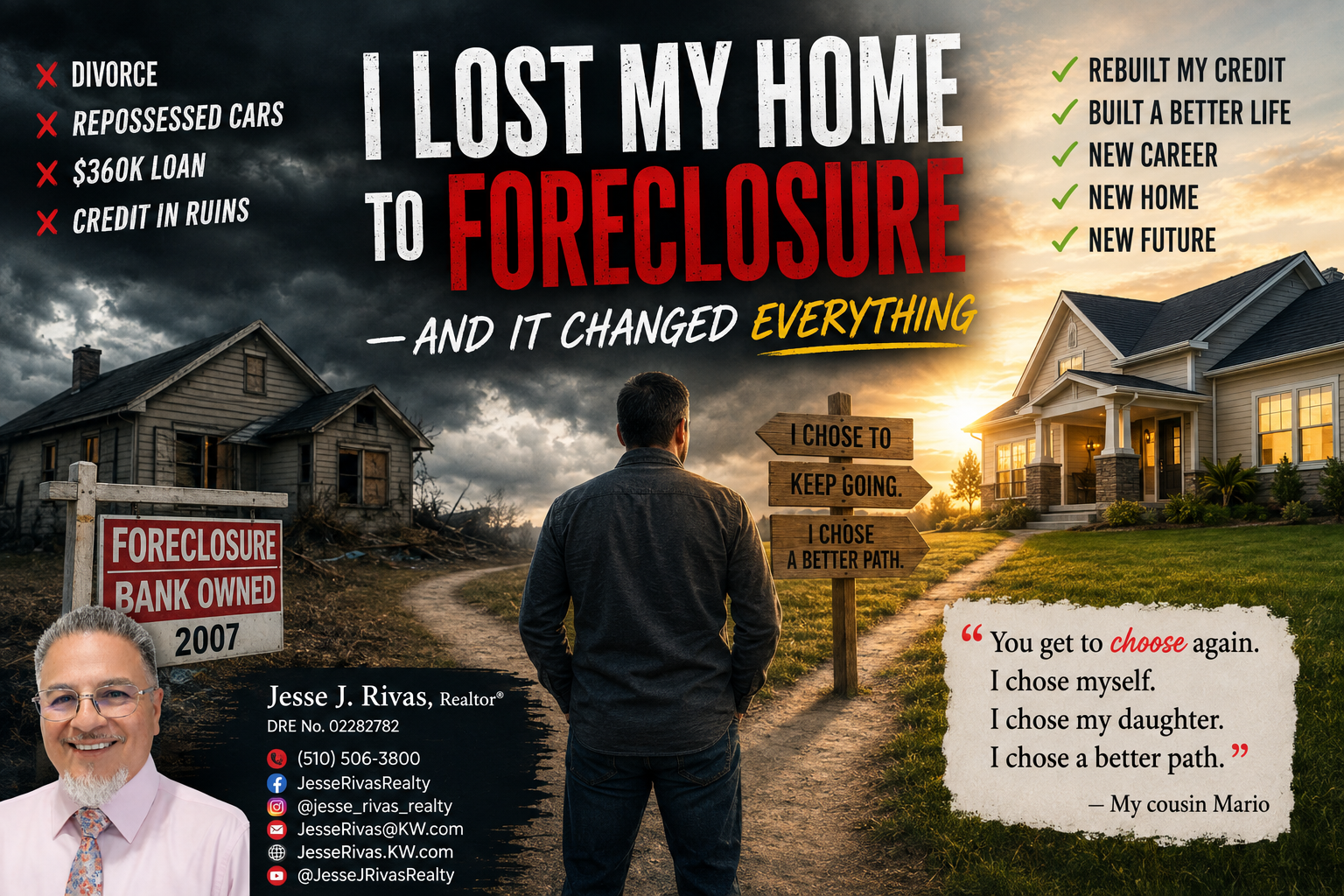
I Lost My Home to Foreclosure — And It Changed Everything
Posted on September 1, 2026 Leave a Comment
By Jesse Rivas | Jesse Rivas Realty | jesserivas.kw.com
I don’t love telling this story. My dad’s voice is always in the back of my head, “You don’t need to brag if you’re doing what you need to do. Your actions say everything.” And I live by that.
But I’ve come to believe that sharing what I went through isn’t bragging. It’s being real. And if one person reads this and feels less alone or finds a path forward they didn’t know was there, then it’s worth it.
The Dream Home
Around 2005, I bought a new-construction home in Newman, California, a small town in the Central Valley. Four bedrooms, single-story, about 2,000 square feet. I did all the upgrades. Marble entryway. The works. My mom was there when I was buying it, and she said, “Son, this is your dream home. Get everything you want.” And I did.
I paid around $325,000 for it. In those early days, the value was still climbing; it hit about $400,000. I refinanced within the first year, pulled some money out for things I was trying to do, and the loan went up to around $360,000. I thought I was doing everything right.
When Everything Started to Unravel
Then the housing bubble burst, and my personal life started unraveling at the same time.
I was going through a divorce. My daughter was four years old. I was an hour and a half away from my parents in Oakland, working a contract job while trying to get on permanently so I could get benefits for her. I lost two cars to repossession, including a supercharged Monte Carlo I absolutely loved. The home value crashed to around $120,000. And I was sitting there with a $360,000 loan.
I tried everything to make it work. Roommates. Borrowing money. Kicking the can down the road. But that’s never a good financial philosophy; you always have to pay the piper eventually. And eventually, it came.
The Decision
It was my dad who finally said it plainly: “Son, it’s time. You have to make a decision.”
So I let the house go. It went into foreclosure in 2007. And that was one of the hardest things I’ve ever done, not just financially, but emotionally. Losing your home feels like failure. It hits your pride, your sense of identity, your plans for the future. All your goals have to be re-shifted. Add in the divorce, a four-year-old, lost cars, and credit in ruins, it was a lot.
Starting Over — With Nothing But a Promise
I moved back in with my mom and dad in Oakland. I was almost 40. It wasn’t easy on the pride. But they were good about it; I think they genuinely liked having my daughter and me there. Still, I knew I couldn’t stay.
We moved to an apartment in Alameda. It was noisy. It didn’t feel right for my daughter. And on the second night in that apartment, I made her a promise: we are going to buy a house.
I started with the credit. Negotiated the old collection accounts and repossession balances, almost $40,000 worth, down to something manageable. Paid off the small debts first. Chipped away one thing at a time. Baby steps.
I found a great job, one I would go on to keep for 17 years. Went back to school and got my bachelor’s degree. Then my MBA. Started working toward my doctorate. Stayed focused on the goal.
The Turning Point
There was a moment at a Warriors game when I ran into my cousin Mario. We sat together, and I started telling him everything that was going on. He looked at me and said: “Cousin, it’s okay. Think of it like this: you get to choose again.”
Those words hit differently than he probably intended. For me, it meant choosing myself and my daughter. Choosing a better path. Choosing to keep going.
Five Years Later — A New Home
A few years after the foreclosure process wrapped up, I took over someone’s apartment lease in Alameda. Renewed it once. And then, when that year was up, we were done with apartments. We moved into a beautiful home in Bay Point.
Five years from foreclosure to homeowner again. Not because it was easy, but because I was relentless about the steps.
What I Know Now (That I Wish I Knew Then)
Being in real estate now, I can look back and see options I didn’t know I had at the time. I could have rented the house and covered part of the loss each month until values recovered. And they always recover; the housing market always comes back up. It’s just a matter of time and strategy.
If I’d had a different job situation, I might have made different choices. And if I’d had a knowledgeable, honest real estate agent in my corner, someone who actually understood my situation, my story might have gone differently.
That’s part of why I do what I do.
If You’re Going Through Something Similar — Let’s Talk
Whether foreclosure feels like it’s coming, has already happened, or you’re just trying to figure out your next move, reach out. There’s no judgment here. Just honest conversation and real options.
Wherever you are right now, we can start planning the pathway forward today.
Jesse J. Rivas, Realtor®
DRE No. 02282782
(510) 506-3800
Facebook: JesseRivasRealty
IG: @jesse_rivas_realty
Email: JesseRivas@KW.com
Website: JesseRivas.KW.com
YouTube: @JesseJRivasRealty
3 Things That Determine Whether Your Home Sale Is Smooth or Frustrating
Posted on August 26, 2026 Leave a Comment
A straight-talk guide for sellers in Lodi, Stockton, and the Central Valley.
By Jesse J. Rivas, Realtor® | Keller Williams Central Valley | Mid-Year 2026
Every week I talk to homeowners who are thinking about selling. And I’ll be honest with you: the difference between sellers who have a smooth, profitable experience and those who end up frustrated almost always comes down to the same three things.
In a market like this one, balanced, selective, more thoughtful than in the frenzy years, these three things matter more than ever. Let me walk you through each one.
| 01 | Price It Right From the Start Your pricing strategy is the single biggest factor in how your sale goes. A sharp launch price is not a sign of desperation. It’s a strategy. |
This is the mistake I see sellers make over and over: they want to test the market at a high price and see what happens. Here’s what actually happens: you sit on the market. Buyers see the days ticking up and assume something must be wrong with the house. Eventually you have to drop the price. And you end up netting less than if you had priced it correctly from day one.
With homes averaging 40 to 47 days on the market across our area right now, this is a real and costly mistake. Buyers are doing their homework. They’re comparing your home to everything else available at your price point. They know the market.
What wins: Pricing based on real, current data, not what your neighbor got in 2022, not what Zillow’s algorithm says, not what you need to clear for your next purchase. What the market is actually willing to pay, right now.
That’s the conversation I have with every seller I work with. Not the number you want to hear, the number that gets you to the closing table.
| 02 | Presentation Wins Every Time The homes selling fastest right now have one thing in common: they’re ready. Most buyers have their first showing online, before they ever set foot in your home. |
Here’s something I always tell sellers: the first showing most buyers do is on their phone. If your listing photos don’t stop the scroll, they move on. Simple as that. We’ve all done it.
I walk through every home I list and give sellers a specific prep list. It doesn’t have to be expensive. But the right preparation makes a real difference in how fast your home sells and for how much.
Here’s what matters most:
- Clean and declutter — Buyers need to picture themselves living there, not around your stuff.
- Fresh paint where needed — One of the highest-ROI updates you can make before listing.
- Curb appeal — Cleaned-up landscaping and a welcoming front entrance set the tone before anyone steps inside.
- Professional photography — This is non-negotiable in today’s market. Phone photos don’t cut it.
- Staging key rooms — Living room, primary bedroom, kitchen. It doesn’t have to be everything.
The homes that are sitting 47+ days on the market right now are almost always the ones where presentation was treated as an afterthought. Don’t let that be your home.
| 03 | Don’t Go It Alone In a compressed, selective market, strategy matters more than it did in 2021. The difference between a home that sells and one that sits often comes down to who’s in your corner. |
I’m not saying this just because I’m a Realtor. The data backs this up. In 2021, when inventory was at historic lows and buyers were waiving contingencies to compete, almost anything sold quickly. That’s not this market.
Today’s buyers have options. They’re being thoughtful. They’re negotiating. And the sellers who are getting the best outcomes have someone who knows how to navigate that, someone who understands pricing conversations, knows the local competition, can position your home correctly, and can negotiate effectively when it counts.
What you deserve: Someone who knows this market, is honest with you about what your home is worth, and is going to work hard to get you to the closing table.
I’ve personally bought six homes, sold four, and yes, lost one to foreclosure. I know what’s at stake when you sell. I bring all of that experience to the table every time I work with a seller.
The Opportunity Is Real — You Just Need the Right Plan
The Central Valley market in 2026 isn’t the frenzy of 2021. But it’s also not the crash of 2008. It’s a market where serious buyers are out there every single week, with over 100 closings per week in San Joaquin County last year alone.
Lodi prices are up 6.8% year-over-year. Inventory is down 12%. Stockton saw 189 homes sell in a single month. Tracy is up 22% in sales volume. The opportunity is real.
You just need to approach it with the right plan.
| Let’s Talk About Your Home I offer free, no-pressure home valuations across Lodi, Stockton, Tracy, Manteca, and the Central Valley. You’ll walk away with a clear picture of what your home is worth today and what a sale would actually look like for your family. Text or DM “VALUE” — I’ll reach out personally. Zero obligation. 📞 (510) 506-3800 | ✉ JesseRivas@KW.com | 📸 @jesse_rivas_realty | 🌐 JesseJRivas.com |

The Real Numbers: Mid-Year 2026 Central Valley Market Report
Posted on August 25, 2026 Leave a Comment
What’s actually happening in Lodi, Stockton, Tracy & Manteca, and what it means for your next move.
By Jesse J. Rivas, Realtor® | Keller Williams Central Valley | Mid-Year 2026
If you own a home in Lodi, Stockton, or anywhere in the Central Valley and you’ve been thinking about selling, here’s my promise to you: I’m going to give you the real numbers. Not the headlines, not the hype, just what’s actually happening in your neighborhood right now, and what it means for your next move.
I pulled the actual mid-year market data for San Joaquin County, city by city, and I’m going to break it all down in plain English so you can make a smart decision for your family.
First, The Big Picture: San Joaquin County
Before we look at your specific city, here’s some important context about the county as a whole, because it changes everything about how you think about this market.
Here’s a stat that surprises almost everyone I tell it to:
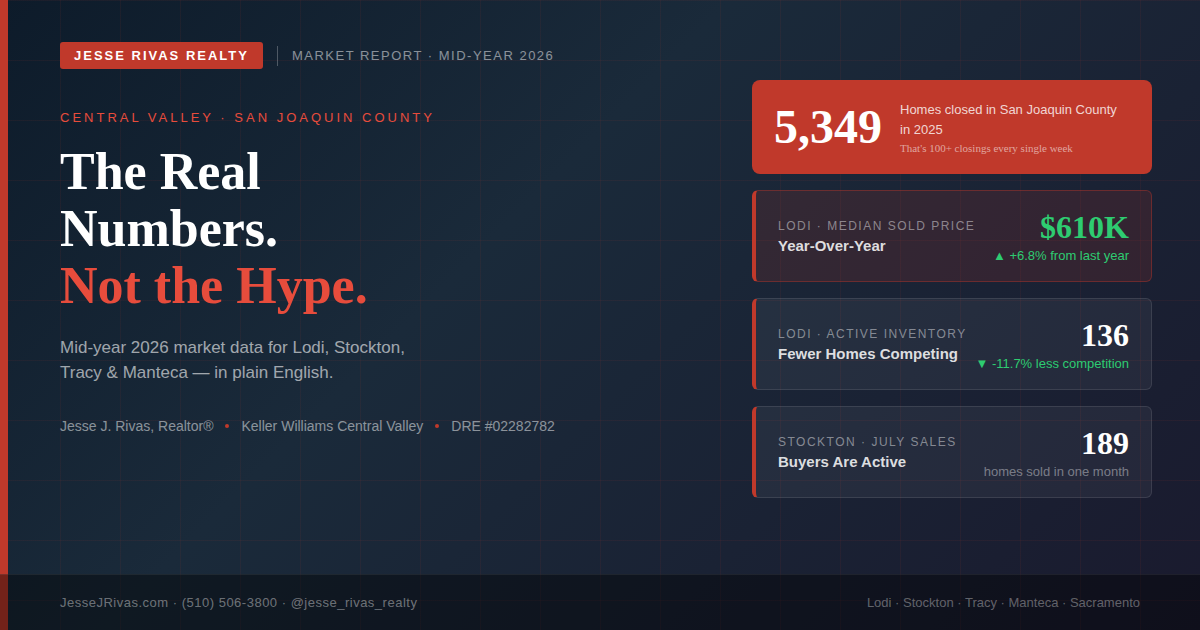
| 5,349 Homes Closed in San Joaquin County in 2025 — That’s 100+ closings every single week. |
If someone told you nobody’s buying right now, that’s just not true. Over 5,000 families bought or sold homes in this county last year. The market has not stopped.
Now, is it the wild ride of 2021 and 2022, when homes were getting 20 offers in 48 hours? No. It’s not that market. But for a seller who knows what they’re doing, this market is still very workable. Let me show you why.
The Three Eras of San Joaquin County
To understand where we are today, it helps to understand where we’ve been:
- Boom & Dislocation Era (2004–2010)
- Normalized Activity Era (2013–2021)
- Today’s Compression Era (2022–Present)
We’ve gone through the bubble, the crash, the long recovery, and the pandemic frenzy. Now we’re in what the data calls a compression era: fewer total transactions, but prices are holding, and in some cities, actually going up.
What compression means for sellers: the buyers who are out there right now are serious. They’re not tire-kickers. Homes that are priced right and show well are still selling. The market is just more selective now, and selective markets reward sellers who do things right.
Lodi: One of the Strongest Markets in the County
If you own a home in Lodi, you’re sitting in one of the best-performing markets in San Joaquin County right now. Here’s what the numbers show when we compare July 2025 to July 2026:
| $610K Median Sold Price | +6.8% Year-Over-Year | 136 Active Inventory | -11.7% Inventory Change |
| 53 Sold Units (July) | +6% Units Change | 47 days Days on Market | Balanced Market Trend |
What This Means for Lodi Sellers
Home prices in Lodi are up nearly 7% compared to a year ago. That’s meaningful money. On a $575,000 home, a 7% increase is over $40,000 in equity that wasn’t there last year. That’s a significant jump.
At the same time, inventory, meaning the number of homes competing with yours for buyers, is actually down 12%. Fewer homes on the market is great news for sellers. You’re dealing with less competition.
Days on market did tick up from 40 to 47, meaning homes are taking about a week longer to sell than last year. Here’s my honest take on that: this is not a set-it-and-forget-it market. You can’t just stick a sign in the yard and expect 2021 results.
What’s Winning in Lodi Right Now
- A polished launch: great photos, smart staging, right pricing from day one
- Homes that are priced accurately and show well are capturing buyer demand quickly
- The homes sitting at 47+ days are the ones that are overpriced or need visible work
Prices are up. Inventory is down. If you’ve been on the fence about selling, the data is genuinely in your favor right now. This could be one of the best windows Lodi sellers have seen in a while.
Stockton: Stable, Active, and Working for Smart Sellers
Stockton tells a slightly different story than Lodi, but it’s still a story that works for sellers. Here’s the mid-year data:
| $445K Median Sold Price | +0.7% Year-Over-Year | 499 Active Inventory | +4.6% Inventory Change |
| 189 Sold Units (July) | Flat Units Change | 40 days Days on Market | Balanced Market Trend |
What This Means for Stockton Sellers
Prices in Stockton are holding steady, up slightly from a year ago, but essentially flat. In an environment where interest rates have kept many buyers on the sidelines, flat prices mean your home’s value is being protected. That’s actually good news.
Where Stockton differs from Lodi is inventory: buyers here have a few more options to choose from. That means homes that stand out through condition, presentation, and pricing are the ones that sell.
189 homes sold in Stockton in July alone. Buyers are absolutely active. They’re just being careful, comparing options, and not going to overpay for a home that isn’t ready.
What I Tell Every Stockton Seller
“Condition and pricing are everything. If your home is move-in ready and priced where the market actually is, not where you wish it was two years ago, you will find a buyer. No doubt about it.”
The buyers are out there. You just have to give them a reason to choose your home.
Tracy & Manteca: Quick Snapshots
Tracy — One of the Stronger Stories in the County
| $724K Median Sold Price | +3.4% Price Change | +22% Sold Units | Balanced Market Trend |
Tracy is one of the stronger performers in the county right now. Median sold prices are up 3.4%, and sold units jumped over 22% year-over-year. It’s a growing community with a lot of new construction, and the data leans seller-friendly.
Manteca — Growing Values, Patient Buyers
| $640K Median Sold Price | +4.1% Price Change | +17% Sales Volume | Mixed/Balanced Market Trend |
Manteca is showing solid growth; values are up 4.1% to $640K, and sales volume jumped nearly 17%. However, homes are taking about 12 days longer to sell than last year, and list prices have softened a bit. The message for Manteca sellers: don’t get aggressive on price. Buyers are value-sensitive, but demand is still active.
The Bottom Line
Every city behaves differently. Every neighborhood behaves differently. That’s exactly why countywide averages only tell part of the story; you need someone who knows your specific market.
But here’s what holds true across all of San Joaquin County right now: the market is alive. Over 5,300 homes closed here last year. Buyers are out there and they’re active. The opportunity is real. You just need to approach it with the right plan.
| Find Out What Your Home Is Worth — Free, No Pressure I do free home valuations for homeowners across Lodi, Stockton, Tracy, Manteca, and the Central Valley. You’ll walk away with a clear picture of where your home stands, zero obligation. Text or DM me “VALUE” and I’ll reach out personally. 📞 (510) 506-3800 | ✉ JesseRivas@KW.com | 📸 @jesse_rivas_realty | 🌐 JesseJRivas.com |
Jesse J. Rivas, Realtor® | DRE No. 02282782 | Keller Williams Central Valley | Broker DRE No. 02324551


Recent Comments